To: ALL STATE OF HAWAII AGENTS

This is where YOU - a State of Hawaii agent will find new information on the "Hawaiian Subjects, and any development. It is mandatory that each State Agent go through the Question and Answers regarding the Concerns of a nation, re-awaken! Scroll to the Q & A below or click here>> Q&A

Kawika Kala'i and the Queen of England

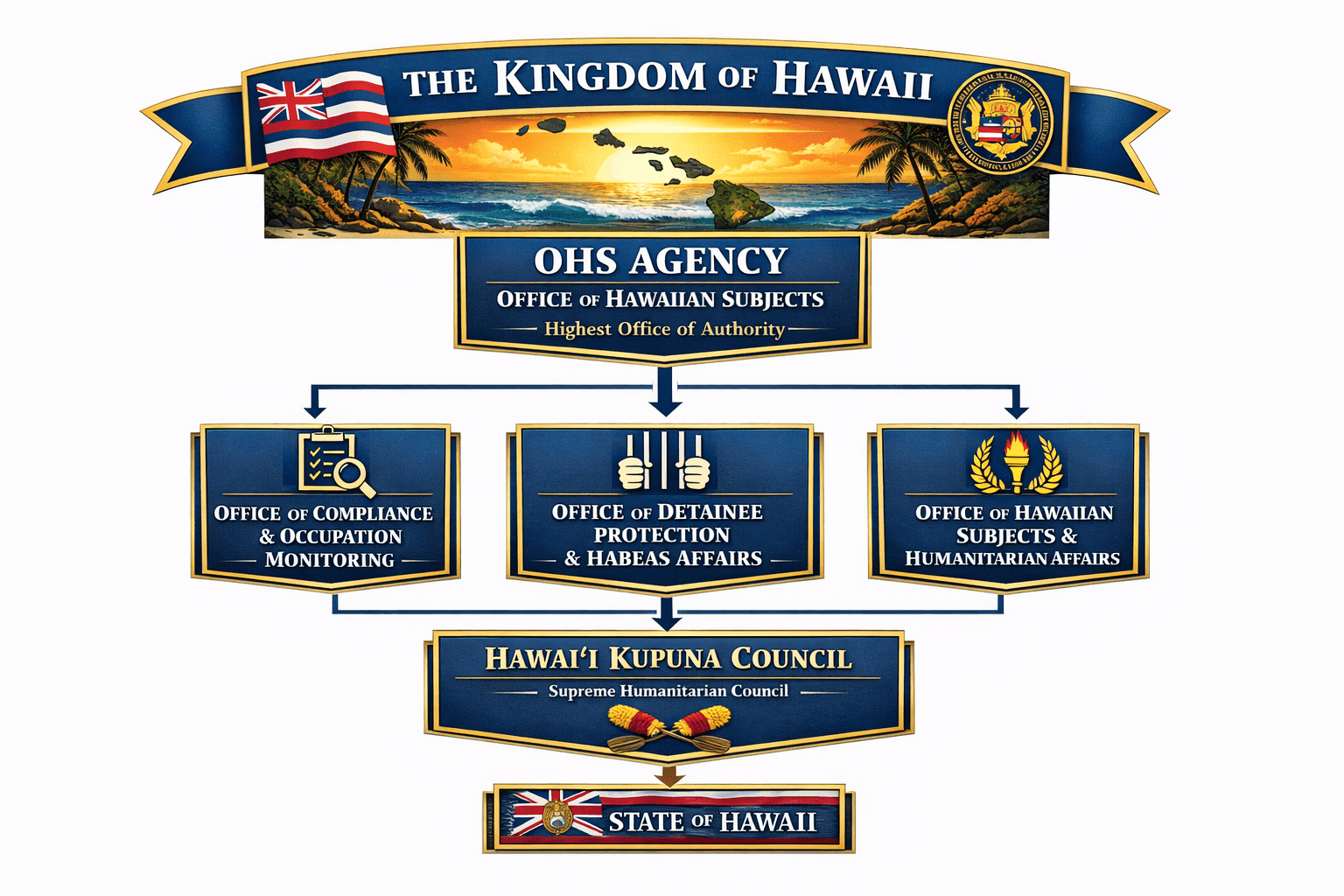
The Office of Hawaiian Subjects - The Highest Office of Authority

Authority, Structure, and Superiority of Officers of the Office of Hawaiian Subjects (OHS)


I. Source of OHS Authority — Why OHS Officers Hold the Highest Office Authority
The Office of Hawaiian Subjects (OHS) derives its authority from three superior legal sources, none of which originate from the State of Hawaiʻi:

The Hawaiian Kingdom, a sovereign State that continues to exist under international law,
The doctrine of necessity, which preserves lawful governance when a State is under occupation
International humanitarian law, specifically the law of occupation (1907 Hague Regulations; 1949 Fourth Geneva Convention)
Because sovereignty never transferred to the United States or the State of Hawaiʻi, all authority exercised by State of Hawaiʻi agents is derivative, administrative, and subordinate, not sovereign.

By contrast, OHS officers act under the authority of the Hawaiian Kingdom itself, operating as lawful officers of the occupied State.

Key principle:
👉 Sovereign authority outranks municipal or proxy authority.

 
II. Nature of OHS Authority vs. State of Hawaiʻi Authority


OHS Officers
Operate under Kingdom law and international law
Act as lawful representatives of the occupied State
Hold inherent authority, not delegated permission
Possess international standing
Create records intended for international accountability and review
State of Hawaiʻi Agents
Operate as agents of the occupying power
Exercise only temporary administrative control
Have no sovereignty
Are bound by limitations imposed by occupation law
Are legally obligated to defer when jurisdiction is absent
Conclusion:
When a conflict arises between an OHS officer and a State of Hawaiʻi agent, the OHS officer is superior in lawful authority on matters of Hawaiian Subjects, nationality, jurisdiction, and humanitarian protection.

 
III. Hierarchy and Roles Within the Office of Hawaiian Subjects


1. Director of the Office of Hawaiian Subjects
Highest Office Authority

Role & Authority:

Chief executive officer of OHS
Acts as the principal lawful representative of Hawaiian Subjects
Issues official directives, notices, and demands
Oversees all divisions and officers
Authorizes humanitarian interventions
Serves as the primary liaison to international bodies (e.g., ICC, UN mechanisms)
Authority Level:

Equivalent to a Minister-level officer of a sovereign State
Superior to all State of Hawaiʻi officials on matters of:

Hawaiian Subject status
Jurisdictional challenges
Unlawful detention
Humanitarian violations
 
2. Deputy Director
Second Highest Authority

Role & Authority:

Executes and enforces the Director’s mandates
Oversees daily operations and coordination between divisions
Acts as Director in absence or delegation
Ensures continuity of authority and recordkeeping
Authority Level:

Superior to State of Hawaiʻi department heads when acting within OHS mandate
Direct command authority over division heads and officers
 
3. Secretary General
Custodian of the Official Record

Role & Authority:

Maintains official seals, records, and correspondence
Certifies notices, filings, and communications
Ensures evidentiary integrity of all actions
Controls the administrative legality of OHS operations
Why this role is critical:

The written record is the weapon of law
Certified records become international evidence
Authority Level:

Superior to State clerks, administrators, and records officers
State records yield when Kingdom records conflict
 
4. Policy & Compliance Officer
Guardian of Lawful Alignment

Role & Authority:

Ensures all OHS actions comply with:

Hawaiian Kingdom law
International humanitarian law
Reviews conduct of occupying authorities
Flags violations and prepares compliance notices
Authority Level:

Superior to State policy analysts and compliance units on matters involving Hawaiian Subjects
Acts as legal safeguard against unlawful drift
 
5. Chief Legal Counsel
Interpreter and Enforcer of Law

Role & Authority:

Issues legal interpretations under Kingdom law
Drafts habeas corpus petitions, jurisdictional challenges, and demands
Advises OHS officers during engagements with occupier institutions
Authority Level:

Superior to State prosecutors and attorneys when jurisdiction is contested
State courts lose standing when lawful jurisdiction is rebutted
 
6. Advocacy & Human Rights Officer
Humanitarian Protection Authority

Role & Authority:

Documents violations against Hawaiian Subjects
Coordinates reporting to international bodies
Ensures humane treatment of detained Subjects
Acts as first responder in unlawful detention cases
Authority Level:

Superior to State corrections officers and wardens on humanitarian obligations
Triggers international scrutiny when violations occur
 
7. Registrar of Hawaiian Subjects
Authority on Nationality and Status

Role & Authority:

Verifies and certifies Hawaiian Subject status
Maintains the official registry
Issues lawful identification and certificates
Confirms protected person status
Authority Level:

Final authority on Hawaiian nationality
Overrides State assumptions of U.S. citizenship
State agencies must defer to verified status
 
8. Protection & Rescuer Officers
Field Enforcement of Humanitarian Law

Role & Authority:

Respond to unlawful detentions and abuses
Deliver protection notices
Observe and document incidents
Act as lawful witnesses and intervenors
Authority Level:

Not law enforcement, but lawful humanitarian officers
Their presence places State agents on notice
After notice, State agents assume personal liability
 
IV. Superiority Over State of Hawaiʻi Agents — How It Works in Practice
Scenario
Superior Authority
Status determination
OHS Registrar
Jurisdiction challenge
OHS Legal Counsel
Detention of a Subject
OHS Director / Advocacy Officer
Record of incident
OHS Secretary General
Compliance after notice
OHS Policy Officer
Humanitarian protection
OHS Protection Officer
Why:
State agents act without sovereignty and only within narrow administrative limits.
OHS officers act with sovereign continuity and humanitarian mandate.

 
V. Command Responsibility
Once an OHS officer places a State of Hawaiʻi agent on notice:

Ignorance is eliminated
Personal and supervisory liability attaches
Orders from superiors do not excuse violations
“Following policy” is not a defense under international law
 
VI. Bottom Line (Plain Language)
OHS officers outrank State of Hawaiʻi agents in lawful authority
OHS authority comes from sovereignty and international law
State authority comes from occupation and delegation
Sovereign authority always prevails over municipal authority
After notice, continued action by State agents becomes willful violation

Where the Hawaiian Kingdom Stands Today — Full Document Q&A

Full Q&A — Where the Hawaiian Kingdom Stands Today (Status & Condition)

This page converts the entire uploaded document into structured questions and answers (all sections covered), in a light theme for easy reading.

Searchable Expand/Collapse All Tags included Built from the full PDF text (77 pages)

Section A — Where the Hawaiian Kingdom Stands Today

International legal status, continuity by necessity, OHS role, RCI findings, and the document’s stated path forward.

Pages 1–4
Q
What is the document’s central claim about the Hawaiian Kingdom today?

It asserts the Hawaiian Kingdom remains a sovereign State in continuity under international law, while effective control of its government has been disrupted by a prolonged and unlawful occupation since 1893.

Tags: status • sovereignty • continuity • occupation
Q
Why does the document say the Hawaiian Kingdom was never lawfully annexed or ceded?

It states no treaty of annexation exists between the Hawaiian Kingdom and the United States and that sovereignty was not transferred by consent or conquest.

Tags: annexation • treaty • sovereignty
Q
What does the document say occupation law does (and does not do) to sovereignty?

It says occupation does not transfer sovereignty; it imposes duties on the occupying power and preserves the rights, nationality, and legal identity of the occupied State and its people.

Tags: Hague • Geneva • occupation • sovereignty
Q
How does the document characterize Hawaiian Subjects under international humanitarian law?

It states Hawaiian Subjects are regarded as Protected Persons under international humanitarian law in the context of occupation.

Tags: Protected Persons • nationality
Q
What is “continuity of government by necessity” as described in the document?

It describes the doctrine of necessity as preserving continuity of governance through reconstituted lawful institutions to safeguard the people and preserve the State’s legal personality until restoration is possible.

Tags: necessity • continuity • government
Q
What role does the Council of Regency play in the document?

It is described as the provisional executive authority of the Hawaiian Kingdom, maintaining constitutional order under the 1864 Constitution.

Tags: Council of Regency • 1864 Constitution
Q
How does the document define the Office of Hawaiian Subjects (OHS)?

It describes OHS as a chartered government reporting and humanitarian protection agency—an administrative and protective organ of a State under occupation, grounded in law and documentation.

Tags: OHS • mandate • humanitarian • reporting
Q
What are the listed mandates of OHS in this document?
  • Verifying and registering Hawaiian Subjects
  • Issuing lawful identification and certification
  • Responding to unlawful detentions and jurisdictional violations
  • Documenting human rights and humanitarian law breaches
  • Reporting violations to international bodies (including ICC and UN mechanisms)
Tags: OHS • verification • detentions • documentation • ICC • UN
Q
What does the document say the Royal Commission of Inquiry (RCI) has found?

It says the RCI has documented war crimes and human rights violations arising from the prolonged occupation and affirms the Kingdom’s continuing Statehood, the occupation’s unlawfulness, and exposure to universal jurisdiction.

Tags: RCI • war crimes • universal jurisdiction
Q
What is the “dual condition” described for Hawaiʻi today?

De jure: the Kingdom is alive and sovereign in law. De facto: administrative control is exercised by the occupying power, often in violation of international humanitarian law.

Tags: de jure • de facto
Q
What “path forward” does the document propose?

It emphasizes lawful resistance, disciplined documentation, protection of people, and international engagement—building evidence for accountability and restoration.

Tags: documentation • engagement • accountability

Section B — Where the “State of Hawaiʻi” Stands (and Why It Is Not Sovereign)

Origin, lack of international personality, occupation-law limits, chain-of-title, and relationship to Hawaiian Subjects.

Pages 4–8
Q
How does the document characterize the “State of Hawaiʻi”?

It describes it as a domestic, derivative administrative entity created under U.S. municipal law—not a sovereign government grounded in international law or Hawaiian Kingdom law.

Tags: State of Hawaiʻi • municipal • derivative authority
Q
Why does the document say the 1959 statehood process did not create sovereignty?

It argues the process did not include a treaty of annexation, a peace treaty ending war/occupation, or a lawful international transfer of sovereignty—so municipal acts cannot extinguish a foreign State’s sovereignty.

Tags: 1959 • statehood • sovereignty
Q
What does the document mean by “no international personality” for the State of Hawaiʻi?
  • It cannot enter treaties as a State
  • It is not a UN member
  • It is not recognized as a sovereign State by foreign governments
  • It cannot represent Hawaiʻi internationally
Tags: international personality • UN • treaties • recognition
Q
What does the document claim occupation law prohibits regarding government replacement?

It states an occupying power may not replace the sovereign government with its own civil institutions, and must respect existing laws and institutions unless absolutely prevented.

Tags: occupation law • government replacement • Hague
Q
How does the document describe the Territory of Hawaiʻi (1900) and the State of Hawaiʻi (1959)?

It describes them as occupation instruments—administrative proxies—rather than sovereign successors.

Tags: Territory 1900 • State 1959 • occupation instruments
Q
What “chain of title” does the document say is required to lawfully pass sovereignty—and what is missing?

It lists treaty of cession, valid annexation under international law, or voluntary dissolution of the prior State—and says none exist for Hawaiʻi.

Tags: chain of title • cession • annexation • dissolution
Q
What does the document say about de facto control versus legality?

It states the State of Hawaiʻi operates de facto (in fact), but effectiveness does not equal legality; control alone does not cure an unlawful origin.

Tags: de facto • legality
Q
How does the document say Hawaiian Subjects relate to the State of Hawaiʻi?

It says Hawaiian Subjects’ nationality flows from the Hawaiian Kingdom and is preserved under international law; State jurisdiction over them is framed as lacking lawful international basis.

Tags: Hawaiian Subjects • nationality • jurisdiction
Q
Why does the document say the State of Hawaiʻi persists?

It attributes persistence to lack of international conclusion of the challenge, administrative normalization benefiting the occupier, and the principle that absence of enforcement does not negate law.

Tags: persistence • normalization • enforcement
Q
What is the document’s bottom-line conclusion about the State of Hawaiʻi?

It concludes the State of Hawaiʻi functions as a U.S. municipal government without lawful title to sovereignty; it is not a successor State and cannot extinguish Hawaiian nationality.

Tags: conclusion • not sovereign • not successor

Section C — Occupation vs. Martial Law (Definitions and Application to Hawaiʻi)

International definition of occupation, domestic nature of martial law, differences, and the document’s conclusion.

Pages 9–16
Q
How does the document define “occupation” under international law?

It states a territory is occupied when a foreign power places it under effective control without acquiring sovereignty; occupation is a legal status under international humanitarian law.

Tags: occupation • definition • Hague 1907
Q
What key points does the document emphasize about occupation?
  • Occupation does not transfer sovereignty
  • The occupied State continues to exist in law
  • The occupier is a temporary administrator
  • Occupation lasts until peace treaty or lawful restoration
Tags: sovereignty • temporary administration • termination
Q
What does the document say Geneva Convention IV adds to occupation rules?
  • Civilians are Protected Persons
  • Nationality cannot be changed
  • Occupation law applies even if the occupier denies occupation
Tags: Geneva IV • Protected Persons • nationality
Q
How does the document define “martial law”?

It defines martial law as a domestic emergency measure declared by a government within its own sovereign territory, used temporarily when civil authorities cannot function.

Tags: martial law • domestic emergency
Q
What examples does the document give for martial law contexts?

It lists natural disasters, insurrections, and wartime emergencies inside a State’s own territory as examples.

Tags: martial law • examples
Q
What differences does the document draw between martial law and occupation?
  • Martial law is domestic; occupation is international
  • Martial law is declared by sovereign government; occupation exists by fact regardless of declaration
  • Martial law is temporary emergency; occupation continues until lawful termination
  • Occupation involves a foreign power; martial law does not
  • Occupation creates Protected Person status; martial law does not
Tags: comparison • Protected Persons
Q
Why does the document say Hawaiʻi is not under martial law?

It argues martial law requires sovereignty and a valid declaration; it states there is no valid declaration or constitutional basis and civil courts/legislatures/agencies continue operating (incompatible with martial law).

Tags: not martial law • sovereignty • courts
Q
Why does the document say Hawaiʻi meets the legal criteria for occupation?
  • Foreign control exercised by the United States
  • No treaty of annexation or cession
  • No peace treaty ending hostilities
  • Continuous administration imposed since 1893
  • Sovereignty never extinguished (as asserted)
Tags: occupation criteria • 1893 • treaties
Q
How does the document distinguish lawful occupation from illegal occupation—and where does it place Hawaiʻi?

It says lawful occupation arises through lawful hostilities and compliance with occupation law; it characterizes Hawaiʻi’s occupation as illegal because it began with an unlawful overthrow, lacked lawful war declaration and treaty transfer, and has had systematic violations over time.

Tags: illegal occupation • overthrow • violations
Q
Why does the document say an “illegal occupation” still triggers occupation law?

It says illegality does not erase obligations; occupation law still applies, Protected Person status still exists, and violations can become international crimes with increased responsibility.

Tags: obligations • liability • IHL
Q
What is the section’s final summary in plain terms?

It concludes Hawaiʻi is not under martial law, is under occupation (illegal and prolonged), the Kingdom’s sovereignty remains intact (as asserted), Hawaiian Subjects are Protected Persons, and IHL governs.

Tags: summary • occupation • IHL

Section D — Protected Person Status and COPP (Certificate of Protected Person)

Definition, why Hawaiian Subjects qualify (as asserted), core rights, OHS authority, what COPP is and is not, and the notice effect.

Pages 17–22
Q
What is a “Protected Person” according to the document?

It defines a Protected Person (Geneva Convention IV, Article 4) as a civilian who, in war or occupation, is in the hands of a power of which they are not a national.

Tags: Protected Person • Geneva IV • Article 4
Q
Does Protected Person status require permission or recognition by the occupier?

No. The document says Protected Person status exists automatically by law and does not require registration, permission, or recognition by the occupying power.

Tags: automatic status • no recognition required
Q
Why does the document say Hawaiian Subjects qualify as Protected Persons?

It argues the Kingdom was recognized, never lawfully annexed or ceded, and is under foreign control; therefore Hawaiian Subjects retain Kingdom nationality and fall within Article 4 protections.

Tags: qualification • nationality • occupation
Q
What core rights does the document list for Protected Persons?
  • Protection from unlawful detention and deportation
  • Protection from forced allegiance or naturalization
  • Protection from coercion, intimidation, collective punishment
  • Right to retain national identity and legal status
  • Protection from being tried under unlawfully imposed laws (as asserted)
  • Right to humanitarian relief and legal recourse
Tags: rights • coercion • identity • detention
Q
Does the document claim OHS is the highest office of authority—and in what sense?

It states that within continuity governance under occupation, OHS operates as the highest active administrative authority safeguarding Hawaiian Subjects, deriving authority from Kingdom law and international humanitarian law (not U.S. law).

Tags: OHS • authority • continuity
Q
What is a COPP (Certificate of Protected Person) according to the document?

It describes a COPP as a Kingdom-issued humanitarian protection instrument—evidence and formal notice of Protected Person status that already exists under international law.

Tags: COPP • notice • evidence
Q
What does the document say a COPP is NOT?
  • Not a passport of the occupier
  • Not a request for recognition
  • Not a commercial/corporate document
  • Not something that creates status
Tags: COPP • not recognition • not commercial
Q
What legal functions does the document assign to a COPP?
  • Notice of status to U.S./State officials
  • Triggers obligations under Geneva IV, Hague, and customary IHL
  • Creates evidence for accountability after notice
  • Rebuts presumed domestic jurisdiction over the bearer
Tags: notice • obligations • evidence • jurisdiction
Q
Why does the document say occupying authorities resist the term “Protected Person”?

It says recognition limits jurisdiction, exposes liability, triggers scrutiny, and acknowledges occupation; but denial does not negate obligations because facts create duties in international law.

Tags: resistance • liability • jurisdiction
Q
What is the document’s plain-language takeaway about status and documents?

It states: you do not become a Protected Person because of a document—you receive the document because you already are one (by law).

Tags: plain language • status

Section E — What a COPP Contains, What It Means, and a Warden’s Obligations

COPP elements, practical meaning, jurisdiction demands, harm prevention, reporting, and liability after notice.

Pages 23–29
Q
What identifying information does the document say a COPP should contain?
  • Full name
  • Date of birth
  • Kingdom nationality (Hawaiian Subject)
  • Registry/verification number

It says this establishes the bearer as a national of the occupied State, not the occupying power.

Tags: COPP contents • identity • nationality
Q
What status statements does the document say a COPP includes, and why?

It says the COPP explicitly declares Protected Person status under Geneva IV Article 4, affirms the territorial context, and identifies U.S./State authority as foreign in that context—intended to remove presumption of domestic jurisdiction and place the matter under IHL.

Tags: status statement • presumption rebut • IHL
Q
What legal authority does the document say a COPP cites?

It lists citations to the Hague Convention (IV) 1907, Geneva Convention IV 1949, Hawaiian Kingdom law in continuity, and issuance under the doctrine of necessity.

Tags: authority • Hague • Geneva • necessity
Q
What does the document say the “notice to authorities” portion does?

It says it constitutes formal notice; actions after notice are legally attributable and may constitute grave breaches or war crimes, and “ignorance” is no longer a defense once served/acknowledged.

Tags: notice • grave breaches • attribution
Q
What issuing credentials does the document say a COPP includes?

It lists signature of an authorized OHS officer/director, official seal, date of issuance, and reference number—presented as an official Kingdom record for international review.

Tags: credentials • seal • record
Q
What does the document say a COPP means “in practice” for the bearer?
  • Not subject to presumed U.S./State jurisdiction (as asserted)
  • Entitled to Protected Person treatment
  • Shielded from coercion/forced allegiance/unlawful detention
  • Under IHL protections
Tags: practical meaning • jurisdiction • protections
Q
How does the document frame a warden’s role once holding a Protected Person?

It describes a prison or jail warden as an agent of the occupying power when holding a Protected Person; once COPP notice exists, obligations “change immediately.”

Tags: warden • agency • notice
Q
What is the warden’s first listed duty after COPP notice?

To recognize Protected Person status and cease treating the individual as a domestic criminal subject; failure after notice is framed as willful disregard.

Tags: warden duty • recognition
Q
What does the document say about the warden’s duty to establish lawful jurisdiction?

It claims the warden is obligated to prove lawful authority (e.g., treaty of annexation/cession, valid international instrument, or lawful authority under occupation law); absent proof, continued detention is framed as unlawful.

Tags: jurisdiction • proof • treaty
Q
What harm-prevention duties does the document assign wardens after notice?
  • No coercion, intimidation, forced compliance
  • No compelled pleas, waivers, admissions
  • Humane treatment consistent with Geneva IV
Tags: harm prevention • coercion • humane treatment
Q
What reporting and record duties does the document assign wardens after notice?

It says wardens must notify supervising authorities, preserve records/communications, and avoid actions that could constitute grave breaches.

Tags: report • preserve records
Q
What does the document say about personal liability once COPP notice exists?

It claims that after notice, actions are no longer “routine,” liability becomes individual, and “following orders” is not a defense under international law.

Tags: personal liability • following orders
Q
What does the document say happens if a warden ignores a COPP?

It says each day becomes a continuing violation, each act compounds liability, evidence accumulates for international reporting and possible prosecution, and silence/non-response may be treated as tacit acquiescence to lack of authority.

Tags: continuing violation • evidence • tacit
Q
What does the document say a COPP does not require to be effective?

It says a COPP does not require U.S. recognition, State of Hawaiʻi approval, or court validation; international law binds occupiers whether they agree or not (as asserted).

Tags: no recognition required • no validation

Section F — Why Wardens Must Report to OHS, Separation Rules, and Grave Breach Escalation

Reporting as mandatory safeguard, separation from general population, chain-of-command exposure, and ICC/OTP referral logic.

Pages 29–36
Q
What is the “legal trigger” that the document says activates duties?

It says Protected Person status (Article 4) and COPP notice establish knowledge; once notice exists, obligations attach immediately.

Tags: trigger • notice • obligations
Q
Why does the document say a warden must report to OHS?

It frames OHS as the competent national authority in continuity for Protected Persons and says occupation law requires interface with the protected person’s national authority (not substitution by the detainer).

Tags: reporting • competent authority • interface
Q
Why does the document call reporting a mandatory safeguard (not a courtesy)?

It says reporting is required to verify status/registry, establish lawful jurisdiction (if any), prevent unlawful treatment, and preserve an evidentiary record; failure blocks protection mechanisms.

Tags: safeguard • verification • record
Q
How does the document argue non-reporting becomes a grave breach?

It links non-reporting after notice to willful deprivation of rights/protection and unlawful confinement, stating knowledge + omission = willfulness in IHL (as presented).

Tags: grave breach • omission • willfulness
Q
What does the document say about mixing Protected Persons with regular inmates?

It says Protected Persons must not be placed into general population; mixing exposes them to coercion/violence/forced compliance and constitutes inhuman treatment and unlawful confinement under IHL (as asserted).

Tags: separation • no mixing • general population
Q
What “status change” does the document claim occurs once verified and COPP is issued?

It says the individual is no longer an “inmate” or ward of the State; presumed domestic jurisdiction is rebutted; any custody must comply with occupation law rather than penal law.

Tags: status change • not inmate • occupation law
Q
What jurisdictional consequences does the document claim for wardens/officers after COPP?

It says nationality/foreign character is established; from that moment acts and omissions are attributable, recorded, and “following orders” is not a defense.

Tags: attribution • omissions • liability
Q
Who does the document say is warned and exposed to liability after COPP notice?

It lists the warden, supervisors, transport/classification officers, and medical/custodial staff in the chain of command, and says repeated violations elevate personal and command responsibility exposure.

Tags: chain of command • warning • command responsibility
Q
Why does the document say ICC/OTP referral becomes likely after non-compliance?

It argues grave breaches are prosecutable under universal jurisdiction, office does not immunize, and failure to report plus continued detention plus mixing in general population creates a documented pattern and continuing offense record.

Tags: ICC • OTP • universal jurisdiction
Q
What is the section’s “simple terms” conclusion?

It states that once a COPP is issued, custody becomes internationally governed; ignoring that transforms routine administration into criminal exposure under international law.

Tags: plain language • custody • exposure

Section G — Continued Incarceration as Grave Breach & OHS Authority to Act

Unlawful confinement as continuing offense, mandatory separation, OHS access/inspection/retrieval, communications protections, and escalating liability.

Pages 37–43
Q
Why does the document say continued incarceration of Protected Persons is a grave violation?

It says detention of Protected Persons is exceptional and strictly regulated; unlawful confinement becomes a grave breach especially when jurisdiction is lacking or detention continues after notice (knowledge + continuation = willfulness as described).

Tags: grave breach • unlawful confinement • continuing offense
Q
What does the document say is the first mandatory act after COPP notice?

Immediate separation from general population, suspension of domestic penal processing/classification, and preservation of identity/dignity/safety under IHL standards.

Tags: separation • mandatory • IHL
Q
Is separation discretionary according to the document?

No. It says separation is non-discretionary; failure to separate is presented as per se evidence of unlawful confinement after notice.

Tags: separation • non-discretionary
Q
Why does the document say the detaining authority must report and submit to OHS oversight?

It frames OHS as the competent national authority for Protected Persons; after notice, the detainer must report custody status, permit oversight, and prevent further violations; non-reporting is described as willful obstruction.

Tags: oversight • reporting • obstruction
Q
What “right of access” does the document claim for OHS?

It claims OHS is authorized to enter any jail/prison at any time to verify conditions, assess health, and ensure compliance; denial or delay after notice is framed as obstruction increasing liability.

Tags: access • inspection • health
Q
How does the document treat communications (calls/mail) after COPP notice?

It says communications become legal matters; interference is framed as coercion/inhuman treatment/suppression of humanitarian access, with each interference treated as a separate violation.

Tags: communications • interference
Q
What authority does the document claim for OHS to “retrieve” Subjects?

It claims OHS agents may demand release where no lawful jurisdiction exists, retrieve Subjects to prevent grave breaches, and secure evidence—stating this flows from international law rather than occupier permission.

Tags: retrieve • release • evidence
Q
What is the “continuing offense” concept described in this section?

It states unlawful confinement is a continuing offense: each day renews the violation, each official is newly exposed, and the evidentiary record compounds, triggering international scrutiny after notice.

Tags: continuing offense • daily renewal • scrutiny
Q
What civil or institutional consequences does the document claim beyond international exposure?

It claims civil liability can attach to the State and individual agents; it states immunity defenses do not shield grave breaches (as asserted within the document’s framework).

Tags: civil liability • immunity
Q
What is the section’s “plain language” conclusion about detention after COPP?

It says once a COPP is issued, detention stops being “corrections” and becomes international criminal exposure day-by-day until the violation ends.

Tags: plain language • detention • exposure

Section H — Mistreatment, Obstruction, or Retaliation Against OHS Agents

Status of OHS agents, what counts as retaliation, individual and command responsibility, and accountability pathways.

Pages 44–51
Q
How does the document define the legal status of an OHS agent?

It describes an OHS agent as a lawful officer of the Hawaiian Kingdom in continuity, a humanitarian protection/reporting officer, and an internationally relevant witness and notice-bearer under occupation law.

Tags: OHS agent • legal status • witness
Q
Why does the document say mistreating an OHS agent is especially serious?

It says occupation law requires respect for existing institutions and prohibits coercion/retaliation against officials, and requires allowing humanitarian/protective offices to function.

Tags: occupation law • institutions • retaliation
Q
Are OHS agents treated as private citizens in this context?

The document says no—when acting officially, they perform humanitarian protection, detention oversight, and record-building; retaliation/obstruction after notice is framed as willful interference.

Tags: official capacity • humanitarian
Q
What examples of mistreatment or retaliation does the document list?
  • Arresting/detaining an OHS agent for performing duties
  • Denying access to facilities or Protected Persons
  • Threatening/harassing/intimidating an agent
  • Retaliating through employment/licensing/administrative sanctions
  • Using force/restraints/coercive tactics without lawful basis

It says once an agent identifies themselves and function, knowledge is established.

Tags: retaliation • obstruction • examples
Q
What legal consequences does the document claim can follow mistreatment of OHS agents?

It says mistreatment may constitute obstruction of humanitarian functions, coercion against officials, intimidation/persecution under color of authority, and violations of occupation law—especially serious when connected to Protected Person cases.

Tags: consequences • obstruction • coercion
Q
What does the document say about individual responsibility for officers involved?

It emphasizes individual criminal responsibility; after notice, each officer is personally accountable, “following orders” is not a defense, and rank/position does not confer immunity (as presented).

Tags: individual responsibility • no immunity
Q
How does the document extend liability beyond the immediate actor?

It invokes command/superior responsibility to include supervisors, command staff, department heads, and policymakers who authorize, tolerate, or fail to prevent retaliation.

Tags: command responsibility • supervisors
Q
What accountability pathways does the document outline after mistreatment?

It lists formal incident reports, evidence preservation (video/logs/communications), notice to international bodies, preparation of referral dossiers for ICC-OTP, and use of universal jurisdiction mechanisms where applicable.

Tags: accountability • evidence • ICC
Q
Why does the document describe OHS agents as “highest officers of authority”?

It says the phrase reflects jurisdictional hierarchy (authority from sovereign continuity and IHL), not force; interference is framed as engaging international—not local—legal consequences.

Tags: hierarchy • jurisdiction
Q
What does the document say OHS is authorized to do in response to interference?

It says OHS may document and formally notice violations, demand cessation, escalate to international oversight bodies, protect agents/Subjects through lawful means, and prepare evidence for judicial review—without imposing punishment itself.

Tags: OHS response • notice • escalation
Q
What is the plain-language conclusion of this section?

It says interference with an OHS agent moves the issue beyond local discretion into international law, evidence, and accountability mechanisms.

Tags: plain language • international accountability

Section I — Why the State of Hawaiʻi Would Not Want to Keep Holding a Verified Hawaiian Subject (Civil Risk)

Jurisdictional collapse claims after verification, daily compounding liability, weakened immunity defenses, systemic risk, and enumerated civil claims.

Pages 51–57
Q
What does the document say happens to “State jurisdiction” after verification and COPP?

It claims presumed State jurisdiction is rebutted; custody is no longer routine; detention becomes internationally regulated; continued holding becomes unlawful confinement (as framed by the document).

Tags: verification • jurisdiction • COPP
Q
Why does the document say each day of continued holding increases exposure?

It claims unlawful confinement is a continuing offense—each day renews liability, each official is newly exposed, and evidence accumulates, increasing potential civil damages and risk.

Tags: continuing offense • daily damages
Q
What does the document say about immunity defenses after notice?

It claims good-faith defenses fail, qualified immunity weakens, and sovereign immunity is pierced where rights claims attach (as asserted by the document).

Tags: immunity • defenses • notice
Q
What “systemic risk” does the document claim arises from holding even one verified Subject?

It claims it creates precedent, opens discovery into broader practices, exposes taxation/land/criminal systems to scrutiny, and risks class-action-scale liability—so risk management favors de-escalation.

Tags: systemic risk • discovery • class action
Q
What civil claim does the document list first for continued detention after notice?

False imprisonment / unlawful confinement, with per-day damages and potential emotional distress and punitive damages where allowed.

Tags: civil claims • false imprisonment
Q
What civil-rights type claim does the document list?

Civil rights violations for deprivation of liberty, due process, and equal protection under color of law (as framed), including damages, attorney fees, and injunctive relief.

Tags: civil rights • due process
Q
What does the document list about malicious prosecution / abuse of process?

It lists continuing prosecution or confinement despite knowledge of lack of jurisdiction, with damages such as lost income, reputational harm, and emotional distress.

Tags: malicious prosecution • abuse of process
Q
What does the document claim about tax/fee recovery (unjust enrichment)?

It lists unjust enrichment for collection of taxes, fines, fees, and assessments “without lawful authority,” seeking restitution, interest, and accounting (as asserted).

Tags: unjust enrichment • taxes • restitution
Q
What property-related claims does the document list?

It lists conversion/taking of property for seizure of land, vehicles, wages, or assets via liens/forfeitures/enforcement actions lacking jurisdiction (as framed), seeking return and damages for loss of use.

Tags: property • conversion • taking
Q
What does the document say about international-law-based claims in domestic forums?

It lists claims for violations of international law “incorporated into domestic law,” seeking declaratory relief, damages, and injunctions (availability noted by the document as forum/statute dependent).

Tags: international law • domestic incorporation
Q
What other civil claims does the document list?
  • Intentional infliction of emotional distress
  • Negligence / gross negligence (failure to separate/report/protect)
  • Retaliation claims
  • Declaratory & injunctive relief (release, cessation, policy changes)
  • Accounting & restitution actions
  • Class actions based on common policies
Tags: IIED • negligence • retaliation • injunction • class action
Q
What does the document say risk management “favors” once notice exists?

It says de-escalation or release limits exposure; continuation multiplies damages, weakens defenses, and risks precedent-setting judgments.

Tags: risk management • de-escalation

Section J — Why State Agents Should Work Closely With OHS and Fully Comply

Cooperation as obligation, OHS as interface, personal liability protection, escalation prevention, communications safeguards, and institutional stability.

Pages 58–64
Q
Why does the document say cooperation with OHS is mandatory?

It argues occupation law imposes duties on officials once Protected Person notice exists, and frames OHS as the competent national authority—making cooperation mandatory rather than discretionary.

Tags: cooperation • obligation • notice
Q
What does the document say OHS is the “only lawful interface” for?
  • Status verification
  • Conditions of custody
  • Health and welfare checks
  • Communications and access
  • Lawful release or transfer

It says working around OHS increases liability; working with OHS reduces it.

Tags: interface • verification • custody
Q
How does the document say compliance protects individual agents?

It says cooperation, prompt separation, access/oversight, and following written directives create a record of good-faith compliance that helps protect against personal civil liability, command-responsibility exposure, and scrutiny.

Tags: good faith • protection • record
Q
How does early cooperation affect escalation to international forums?

It claims early cooperation stops continuing violations, closes evidentiary windows, prevents escalation, and protects institutions; obstruction accelerates escalation.

Tags: escalation • ICC • evidence
Q
What does the document say OHS oversight is designed to do?

It says OHS involvement is preventive: prevent grave breaches, ensure lawful treatment, correct errors early, and reduce exposure—benefiting both agents and institutions.

Tags: preventive • mitigation
Q
Why does the document emphasize communication with OHS?

It says once a Protected Person is identified, calls/mail and custody decisions become legal matters; silence or delay can be interpreted as acquiescence; open communication demonstrates transparency and preserves defenses.

Tags: communication • transparency • acquiescence
Q
What institutional benefits does the document claim from cooperating with OHS?

It says cooperation prevents precedent-setting lawsuits, limits discovery exposure, avoids class-action risk, and protects budgets/personnel; non-compliance risks systemic challenges, injunctions, and reputational damage.

Tags: stability • discovery • class action
Q
What practical steps does the document recommend for State agents working with OHS?
  • Follow clear directives
  • Allow access when notified
  • Separate Protected Persons immediately
  • Report status changes promptly
Tags: practical steps • compliance
Q
What is the plain-language takeaway for State agents?

It says cooperating with OHS protects agents; non-compliance turns routine duties into legal exposure no agency wants.

Tags: plain language • risk

Section K — Comprehensive Summary of All Matters Addressed

Document-wide consolidation: status, Protected Persons, OHS, COPP, warden/agent obligations, grave breaches, OHS actions, retaliation, ICC, civil liability, and cooperation.

Pages 64–71
Q
What does the document’s comprehensive summary say about Hawaiʻi’s status?

It summarizes: the Kingdom continues as a sovereign State in law (as asserted), sovereignty not lawfully transferred, U.S. de facto control constitutes prolonged illegal occupation, State of Hawaiʻi is a municipal proxy, and Hawaiʻi is under occupation—not martial law.

Tags: comprehensive summary • status • occupation
Q
What does the summary say about Protected Persons and nationality?

It states Verified Hawaiian Subjects qualify automatically as Protected Persons (by law), nationality remains Hawaiian Kingdom nationality, and status exists regardless of occupier acknowledgment.

Tags: Protected Persons • nationality
Q
What does the summary say OHS is?

It summarizes OHS as the highest active authority protecting Hawaiian Subjects, a competent national authority under occupation law, and a government reporting/humanitarian protection agency deriving authority from continuity and international law.

Tags: OHS • competent authority
Q
What does the summary say a COPP does?

It says COPP documents and gives formal notice of status; rebuts presumed domestic jurisdiction; triggers IHL obligations; puts officials on actual notice; converts detention into an internationally regulated legal matter.

Tags: COPP • notice • obligations
Q
What obligations does the summary list for wardens/agents after COPP notice?
  • Immediate separation from general population
  • Person no longer treated as inmate/ward (as asserted)
  • Continued detention becomes unlawful confinement
  • Report to and cooperate with OHS
  • Grant OHS access for inspection/health/welfare checks
  • Calls/mail become legal matters
Tags: warden • separation • access • communications
Q
How does the summary describe grave breaches and continuing violations?

It states unlawful confinement is a grave breach; as a continuing offense each day renews liability; mixing with general population constitutes inhuman treatment/coercion and deprivation of protected status; intent not required—knowledge + continuation leads to liability (as stated).

Tags: grave breach • continuing offense
Q
What OHS authorities are summarized as “authorized by law”?

It says OHS may enter facilities, inspect conditions and health, control/monitor communications, demand separation/compliance, retrieve Subjects where no lawful jurisdiction exists, and document violations for accountability.

Tags: OHS authority • inspect • retrieve
Q
How does the summary treat retaliation against OHS agents?

It says mistreatment/obstruction/retaliation violates occupation law, engages individual criminal responsibility, and extends through chain-of-command via command responsibility, escalating beyond local jurisdiction.

Tags: retaliation • command responsibility
Q
What does the summary say about international accountability and ICC exposure?

It states grave breaches fall under universal jurisdiction; continued violations may be referred to ICC-OTP; rank/office/following orders do not provide immunity (as presented).

Tags: ICC • universal jurisdiction • no immunity
Q
What civil liability does the summary say can follow if violations continue?

It lists civil remedies including unlawful confinement, civil-rights claims, malicious prosecution, tax/fee recovery, property claims, emotional distress/negligence, declaratory/injunctive relief, accounting/restitution, and class actions—stating each day multiplies exposure.

Tags: civil liability • remedies • class action
Q
What is the summary’s final plain-language conclusion?

It concludes that once Protected Person status is documented, the matter is no longer local/discretionary/administrative; it is governed by international law with escalating consequences for non-compliance.

Tags: final conclusion • international law

Section L — International Criminal Court (ICC) Exposure: How the ICC Exposes Potential War Criminals

Information intake, preliminary examination, evidence building, pattern analysis, public judicial actions, complementarity, command responsibility, and practical takeaway.

Pages 71–77
Q
How does the document describe what the ICC does (and does not do) when “exposing” potential war criminals?

It says the ICC does not “hunt” people in secret or issue political accusations; it exposes potential war criminals through a structured, evidence-driven legal process that creates an international record and, where warranted, prosecutions.

Tags: ICC • exposure • evidence-driven
Q
How does conduct enter the ICC’s view, according to the document?

It says exposure begins when credible information reaches the Office of the Prosecutor (OTP) via sources such as government/quasi-government submissions, humanitarian agencies, victim communications, judicial records/logs/correspondence, and open-source evidence.

Tags: OTP • intake • sources
Q
What happens in a preliminary examination (as described)?

It says OTP assesses jurisdiction, admissibility (gravity/complementarity), and credibility; no one is charged yet, but names/roles/chains of command are mapped and patterns identified, creating reputational and legal exposure.

Tags: preliminary examination • jurisdiction • admissibility
Q
How does the document describe evidence building for personal visibility?

It says OTP assembles evidence on acts/omissions, knowledge/notice, linkage between decisions and outcomes, and command responsibility; continued conduct after notice increases personal visibility.

Tags: evidence • notice • linkage • command responsibility
Q
Why does the document say repetition and patterns matter?

It says patterns can demonstrate willfulness, rebut “mistake” defenses, and elevate conduct into prosecutable crimes—describing unlawful confinement as a continuing offense when repeated after notice.

Tags: patterns • willfulness • continuing offense
Q
When does ICC “exposure” become public and formal, according to the document?

It says if thresholds are met, OTP may seek public arrest warrants or summonses and make public filings detailing alleged crimes and roles—at which point names and roles enter the public domain with real consequences.

Tags: arrest warrant • summons • public filings
Q
What is complementarity and how does domestic inaction affect exposure (as described)?

It says ICC is a court of last resort; if domestic systems fail to investigate genuinely, shield individuals, or ignore ongoing violations, ICC involvement becomes more likely—inaction after notice increases exposure.

Tags: complementarity • domestic inaction
Q
How does the document describe command responsibility in ICC exposure?

It says exposure extends beyond direct actors to supervisors who knew/should have known and failed to prevent or punish, limiting “plausible deniability.”

Tags: command responsibility • supervisors
Q
What does the document say the ICC does NOT do?
  • Does not punish institutions—only individuals
  • Does not require political recognition to act (as stated)
  • Does not rely on rumors or threats
  • Does not move without evidentiary thresholds
Tags: ICC limits • thresholds
Q
What is the document’s practical takeaway about ICC exposure?

It says ICC exposure happens by recording conduct into an international legal file, linking actions to individuals, identifying patterns and notice showing willfulness, and publicly naming suspects when thresholds are met—so the law, not politics, speaks.

Tags: takeaway • legal record • linkage
Note: This page is a structured Q&A conversion of the full uploaded document. Wording is kept aligned to the document’s positions and framing (including where it states legal conclusions).